
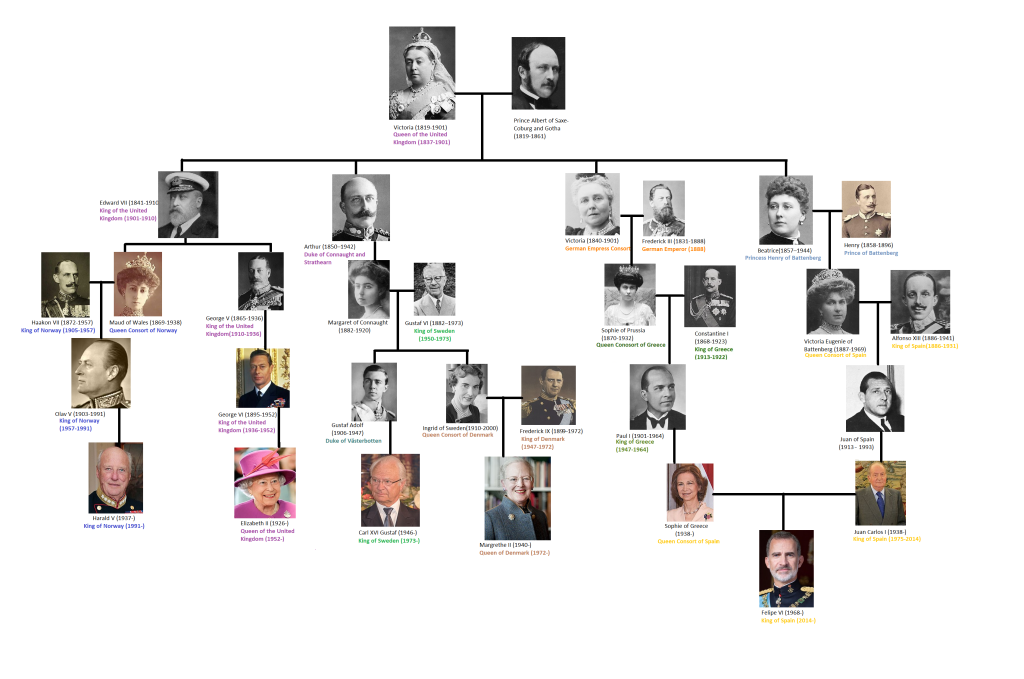
| Name | Family Status | Related To |
|---|---|---|
| Queen Victoria | Monarch | – |
| Prince Albert | Consort | Queen Victoria |
| Victoria, Princess Royal | Daughter | Queen Victoria, Prince Albert |
| Prince Albert Edward, Prince of Wales | Son | Queen Victoria, Prince Albert |
| Princess Alice | Daughter | Queen Victoria, Prince Albert |
| Princess Helena | Daughter | Queen Victoria, Prince Albert |
| Princess Louise | Daughter | Queen Victoria, Prince Albert |
| Prince Arthur | Son | Queen Victoria, Prince Albert |
| Prince Leopold | Son | Queen Victoria, Prince Albert |
| Princess Beatrice | Daughter | Queen Victoria, Prince Albert |
| King Edward VII | Monarch | Queen Victoria, Prince Albert |
| Princess Victoria, Princess Royal | Daughter | King Edward VII, Queen Alexandra |
| Princess Alice, Countess of Athlone | Daughter | King Edward VII, Queen Alexandra |
| Princess Victoria of Hesse and by Rhine | Daughter | King Edward VII, Queen Alexandra |
| Princess Louise, Duchess of Argyll | Daughter | King Edward VII, Queen Alexandra |
| Prince Arthur, Duke of Connaught and Strathearn | Son | King Edward VII, Queen Alexandra |
| Princess Beatrice of Battenberg | Daughter | King Edward VII, Queen Alexandra |
| King George V | Monarch | King Edward VII, Queen Alexandra |
| Prince Albert Victor, Duke of Clarence and Avondale | Son | King Edward VII, Queen Alexandra |
| Prince George, Duke of York (later King George VI) | Son | King Edward VII, Queen Alexandra |
| Prince Henry, Duke of Gloucester | Son | King Edward VII, Queen Alexandra |
| Prince George, Duke of Kent | Son | King Edward VII, Queen Alexandra |
| Prince John | Son | King Edward VII, Queen Alexandra |
| Queen Mary | Monarch | King George V |
| Prince Edward, Duke of Windsor | Son | King George V |
| Prince Albert, Duke of York (later King George VI) | Son | King George V |
| Prince Henry, Duke of Gloucester | Son | King George V |
| Prince George, Duke of Kent | Son | King George V |
| Prince John | Son | King George V |
| Queen Elizabeth II | Monarch | King George VI, Queen Elizabeth |
| Princess Margaret | Daughter | King George VI, Queen Elizabeth |
| Prince Charles, Prince of Wales | Son | Queen Elizabeth II, Prince Philip |
| Princess Anne | Daughter | Queen Elizabeth II, Prince Philip |
| Prince Andrew, Duke of York | Son | Queen Elizabeth II, Prince Philip |
| Prince Edward, Earl of Wessex | Son | Queen Elizabeth II, Prince Philip |
I’m sorry, but it appears you have not provided any specific text that needs rephrasing. Could you please provide the text you wish to have rephrased?
I’m sorry, but it appears you have not provided any specific text that needs rephrasing. Could you please provide the text you wish to have rephrased?
Delving into the intricate world of royal genealogy, one monarch stands out above the rest: Queen Victoria. Not only did she have an enduring impact on Britain during her reign but her children and grandchildren went on to inherit thrones across Europe, giving her the title “Grandmother of Europe“.
My experience studying historical lineages has uncovered some truly fascinating aspects of Queen Victoria’s family tree that I am thrilled to share with you. Whether you’re a history buff or just intrigued by royal intrigue, this blog will take you on a captivating journey through time encapsulating romance, power struggles and significant global events.
Let’s uncover together the myriad branches of Queen Victoria’s sprawling lineage – it promises to be quite an adventure!
Key Takeaways
- Queen Victoria had a significant impact on Europe through her children and grandchildren, who went on to inherit thrones across the continent.
- King Edward VII, Queen Victoria’s eldest son, ascended to the British throne in 1901 and brought about social reforms during his reign.
- Princess Alice, Queen Victoria’s daughter, made notable contributions to improve healthcare standards during the Austro-Prussian War.
The Lineage of Queen Victoria
Queen Victoria’s lineage includes King Edward VII, Princess Alice, King George V, Victoria Mountbatten, King George VI, Princess Alice of Greece and Denmark, Queen Elizabeth II, and Prince Philip.
King Edward VII
King Edward VII, Queen Victoria’s eldest son, ascended to the British throne in 1901 and ruled for nine productive years. His reign introduced significant social reforms and witnessed remarkable diplomatic achievements.
Notably, Edward oversaw the transformation of the British Home Fleet into a force that could rival any world power during his tenure as king. His beloved wife was Queen Alexandra, who played an essential role in his decisions and their dynasty’s prosperity.
Following King Edward VII’s demise, their son George V took over the throne ensuring continuity of their lineage. Today, England still cherishes the memory of King Edward VII through surviving descendants like Queen Elizabeth II, his great-great-granddaughter— now recognized as Britain’s longest reigning monarch ever.
Princess Alice
Princess Alice, the third child and second daughter of Queen Victoria and Prince Albert, held a prominent position in the grand family tree. Born in 1843 at Buckingham Palace, she was christened “Alice Maud Mary” in honor of her father’s aunt.
At an early age, she showed great compassion towards others which later manifested into becoming involved with philanthropic work throughout her life.
Despite personal hardships such as an unhappy marriage to Louis IV, Grand Duke of Hesse, and grieving the death of two children, Princess Alice remained resilient. She poured her energy into helping people around her and made notable contributions to improve healthcare standards during the Austro-Prussian War.
Her lineage continued as one marked by royalty; her daughter Alice married Prince Louis of Battenberg while another descendant became Princess Alice of Greece and Denmark – all partaking in shaping Europe’s royal history just like their forebearers from House Windsor.
King George V
King George V, grandson of Queen Victoria and part of the illustrious lineage, took to the throne in 1910 following his father’s demise. His reign marked a noteworthy transition as he was the first British monarch from the House of Windsor.
Despite existing royal protocols, King George V broke barriers by actively participating in World War I efforts. He not only visited troops stationed at front lines but also contributed significantly to war strategies.
Alongside these military involvements, his kingship witnessed massive socio-political transformations within the United Kingdom, especially a crucial expansion in voting rights which ushered a new era of democratic practices.
Victoria Mountbatten
Victoria Mountbatten holds a prominent place in royal history as Queen Victoria’s great-granddaughter. Not just born into British royalty, she also made an important connection with German nobility through her marriage to Prince Louis of Battenburg.
Their children followed suit, becoming important figures in the British Navy and even ascending to Swedish royalty. Despite these international ties, Victoria’s legacy returned to England through her great-great granddaughter, Queen Elizabeth II.
Her essential role affirms that the impact of Queen Victoria’s lineage extends beyond geographical borders and persists over centuries.
King George VI
King George VI, the father of Queen Elizabeth II, became king after his older brother abdicated the throne. He was associated with the lineage of Queen Victoria through his mother, Queen Mary, who was Victoria’s granddaughter.
King George VI’s reign began in 1936 and lasted until his death in 1952. During his time as king, he played a significant role in leading Britain through World War II. His leadership and resolve helped inspire the nation during one of its most challenging periods in history.
Princess Alice of Greece and Denmark
Princess Alice of Greece and Denmark was a prominent figure in Queen Victoria’s family tree. As the great-granddaughter of Queen Victoria, her lineage can be traced back to the English royal descendants.
Princess Alice’s mother, Victoria Mountbatten, married Prince Louis of Battenburg. Their children went on to become significant figures, with some serving in the British Navy and others marrying into Swedish royalty.
Through Princess Alice’s descendants, her great-grandson is King Charles III and her great-great-grandson, Prince William, holds the position as second in line to the throne. In fact, even her great-great-great-grandson, Prince George, is part of the line of succession.
Queen Elizabeth II
Queen Elizabeth II, the current reigning monarch of the United Kingdom, is a direct descendant of Queen Victoria. She is Queen Victoria’s great-great-granddaughter and her family lineage can be traced back through several generations.
Queen Elizabeth II’s great-grandmother was Princess Alice, who was Queen Victoria’s daughter. Additionally, Queen Elizabeth II’s grandfather was King George V, who changed the royal family name to Windsor.
It is interesting to note that even Prince Philip, Duke of Edinburgh and Queen Elizabeth II’s husband, is also descended from Queen Victoria on his mother’s side. In terms of succession, when Queen Elizabeth II passes away, her eldest son King Charles III will become the next king.
Prince Philip, Duke of Edinburgh
Prince Philip, Duke of Edinburgh, is associated with the lineage of Queen Victoria through his mother’s side. He is Prince Philip’s great-great-grandmother. Princess Alice of Battenberg, Prince Philip’s mother, was Queen Victoria’s great-granddaughter.
Wedding Prince Louis of Battenberg married Princess Alice and they became parents to the Duke.
Queen Victoria’s Influence on European Monarchies
I’m sorry, but it appears you have not provided any specific text that needs rephrasing. Could you please provide the text you wish to have rephrased?
Queen Victoria’s influential lineage extended to various European monarchies, including the Danish, Swedish, Norwegian, and Spanish royal families.
The Danish Royal Descendants of Queen Victoria
Queen Victoria’s lineage has left a lasting impact on various European monarchies, including the Danish royal family. Through marriage and bloodline connections, the Danish royal descendants are intricately connected to other prominent European dynasties.
For instance, Princess Alice of Greece and Denmark, who was Queen Victoria’s great-granddaughter, played a significant role during World War II by hiding a Jewish family and founding a Christian sisterhood.
King Charles III, who became the king of Denmark after Queen Elizabeth II, is now succeeded by his son Prince William as second in line to the Danish throne. These interconnections showcase the influence that Queen Victoria’s family has had on shaping Europe’s regal landscape.
The Swedish Royal Descendants of Queen Victoria
Carl of Sweden, who inherited the position of second in line to the Swedish throne in 1947, became Crown Prince in 1950. In 1973, he took the throne and became the longest reigning monarch in Swedish history.
Victoria of Sweden then became the heir apparent to the throne in 1980 after her father’s ascension. She studied political science and history at Yale, the Swedish Defence University, and Stockholm University before marrying Daniel Westling in 2009.
Together they have two children.
The Norwegian Royal Descendants of Queen Victoria
Queen Victoria’s lineage has had a lasting impact on European monarchies, including the Norwegian royal family. Princess Alice of Greece and Denmark, who was Queen Victoria’s great-granddaughter, played a significant role in shaping the Norwegian monarchy.
Today, King Charles III, who is Queen Victoria’s great-great-grandson, sits on the Norwegian throne after his mother’s passing in 2022. And next in line to succeed him is Prince George, another descendant of Queen Victoria.
The Norwegian royal descendants continue to carry forward the legacy of their famous ancestor.
The Spanish Royal Descendants of Queen Victoria
Queen Victoria’s influence on European monarchies extended to the Spanish Royal Family as well. One of her granddaughters, Princess Victoria Eugenie, married King Alfonso XIII of Spain.
However, their marriage was not without challenges. After Spain became a republic in 1931, King Alfonso XIII was forced into exile along with his family. Despite this turn of events, Queen Victoria’s lineage left a lasting impact on the history of the Spanish monarchy.
Significant Events in Queen Victoria’s Family
I’m sorry, but it appears you have not provided any specific text that needs rephrasing. Could you please provide the text you wish to have rephrased?
Queen Victoria’s family experienced numerous significant events, including the marriages of her nine children, the involvement of her grandchildren in World War I, and various instances of abdication, murder, and disease.
To delve deeper into these captivating occurrences within Queen Victoria’s family tree, continue reading the blog.
Queen Victoria’s Nine Children and their Marriage Alliances
Queen Victoria had nine children, and their marriages formed important alliances. Here is a list of Queen Victoria’s children and their marriage alliances:
- Victoria, Princess Royal: Married Frederick III, German Emperor and King of Prussia.
- Prince Albert Edward, Prince of Wales: Married Alexandra of Denmark.
- Princess Alice: Married Louis IV, Grand Duke of Hesse.
- Princess Helena: Married Prince Christian of Schleswig-Holstein.
- Princess Louise: Married John Campbell, Marquess of Lorne (later Duke of Argyll).
- Prince Arthur, Duke of Connaught and Strathearn: Married Princess Louise Margaret of Prussia.
- Prince Leopold, Duke of Albany: Married Princess Helena of Waldeck and Pyrmont.
- Princess Beatrice: Married Prince Henry of Battenberg.
- Princess Louise, Duchess of Argyll: Married John Campbell, 9th Duke of Argyll.
Family Feud: Victoria’s Grandchildren in World War I
Several of Queen Victoria’s grandchildren and great-grandchildren were involved in World War I, which led to a family feud. Tragically, many of them lost their lives during the war.
This added another layer of sorrow and tragedy to Queen Victoria’s already complex family tree. The impact of the war on the royal descendants was profound and further highlighted the sacrifices made by members of Queen Victoria’s lineage.
Their involvement in World War I serves as a reminder of the devastating consequences that conflict can have on even the most privileged families.
Royal Pains: Abdication, Murder, Disease
Queen Victoria’s family tree is not without its share of royal pains. From abdications to murder and disease, the Queen’s descendants faced numerous challenges. One notable event was the abdication of King Edward VIII, who gave up the throne for love.
Another tragedy was the murder of Grand Duke Louis IV of Hesse and his family during the Russian Revolution. Additionally, several members of Queen Victoria’s lineage suffered from genetic diseases such as hemophilia, which affected multiple generations.
These events highlight the complexities and struggles within this royal bloodline.
Queen Victoria’s Royal Descendants Today
Queen Victoria’s royal descendants continue to play an important role in European monarchies today. Her great-great granddaughter, Queen Elizabeth II, holds the title of the longest-reigning and longest-lived monarch in British history.
She married Prince Philip, Duke of Edinburgh, who also has a descent from Queen Victoria on his mother’s side. Their eldest son, King Charles III, ascended the throne in 2022 upon the death of his mother.
Another notable descendant is Prince George, eldest son of Prince William and second in line to the throne. He too carries on Queen Victoria’s lineage. Additionally, Victoria Mountbatten, another great-granddaughter of Queen Victoria, married Prince Louis of Battenburg.
Their children went on to become influential figures in both the British Navy and Swedish royalty.
The enduring influence of Queen Victoria can be seen through her direct successors who are still active members within their respective royal families today.
Conclusion: The Lasting Impact of Queen Victoria’s Lineage
Queen Victoria’s lineage has had a lasting impact on European monarchies. From the Danish and Swedish royal descendants to the Norwegian and Spanish royal descendants, her family tree extends far and wide.
With nine children, 42 grandchildren, and 87 great-grandchildren, Queen Victoria’s influence continues to be felt today through her numerous royal descendants.
FAQs
1. Who was Queen Victoria?
Queen Victoria, from the House of Tudor, was a significant figure in Europe and ruled the United Kingdom as part of the monarchy during her reign.
2. Can you tell me about Queen Victoria’s husband?
Her husband, Prince Albert of Saxe-Coburg and Gotha, also known as the prince consort, played a leading role in organizing The Great Exhibition.
3. What can we learn about Queen Victoria’s descendants?
Queen Victoria’s descendants include Edward VII, George V and Elizabeth II who have held important roles in European history such as King or Duke.
4. Did any health issues affect Queen Victoria’s family?
Yes, certain members of her family like Princess Alice suffered from diseases like diphtheria; while others inherited haemophilia which had consequences for several European royal families.
5. How did World War I impact Queen Victoria’s lineal descent?
After World War I due to anti-German sentiment in Britain, her grandson George V changed his house name from Saxe-Coburg and Gotha to Windsor.
6. Is there a connection between Queen Victorias’ Family Tree and other European Royal Families?
Indeed! For instance: through marriage alliances with Russian nobility – Alexandra married into the Russian Empire; moreover Elisabeth of Austria is connected via Hapsburg lineage.

Elizabeth Miller is a seasoned family tree researcher with over 16 years of expertise in tracing the genealogies of historical, celebrity, and well-known individuals. Holding relevant qualifications, they actively contribute to genealogy communities and have authored articles for prominent publications, establishing their authority in the field. Elizabeth Miller is dedicated to unraveling the intricate family histories of notable figures, helping clients discover their historical roots. Satisfied clients attest to their trustworthiness and the enriching experience of working with them. As a dedicated storyteller who brings history to life through genealogy, Elizabeth Miller is a reliable and authoritative source for those seeking to explore the family trees of historical, celebrity, and well-known personalities.